
When you work with force measurement technology, numbers on a spec sheet aren’t enough.
As practitioners, researchers, and performance staff, we rely on equipment to do exactly what it claims, especially when athletes are pulling, pushing, and straining against it at maximal effort. If a system claims it can handle 10,000 N, it must be capable of handling 10,000 N. Not almost. Not in theory. In practice.
So, we decided to find out just how strong our system really is.
The Experiment: Taking TruStrength Beyond Its Limits
Aim
To apply tensile force up to and beyond the Gen3 TruStrength’s rated 10,000 N capacity, using a real-world setup that mirrors high-force isometric testing scenarios.
Venue
Hawkin Dynamics in Portlaoise, Ireland
Team
John McMahon, Henry Fingleton, and Patrick O'Keeffe
Equipment Used
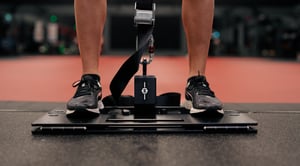
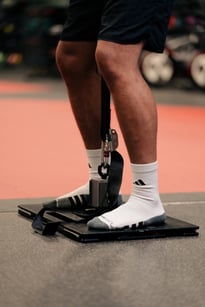
- Gen3 TruStrength
- Portable ISO Platform
- Eyebolt
- Carabiner
- Adjustable Strap
And to generate the force?
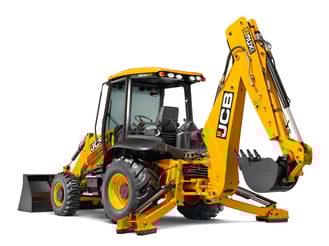
👉 A JCB digger. Yes—an actual digger applying tensile load through the system.
Why Go to These Extremes?
Isometric multi-joint tests like the Isometric Mid-Thigh Pull (IMTP), isometric belt squat, and other high-force tasks place huge demands on equipment.
In these tests:
- Athletes regularly exceed 5–7× bodyweight
- Peak forces can approach or exceed 8,000–9,000 N
- Safety margins matter for athletes and practitioners
If any component in the system is the weak link—load cell, platform, fixings, or connectors—the consequences range from inaccurate data to equipment failure.
This experiment wasn’t about marketing. It was about verification through experimentation.
What We Did
We anchored the Portable ISO Platform into a concrete floor and applied tensile force via the TruStrength system using the JCB digger. The load was increased progressively, with multiple high-force repetitions.
To ensure transparency and validation:
- A wide-angle camera captured the full setup
- A vertical phone camera recorded close-up perspectives
- The Hawkin Capture app was screen-recorded to show live force data in real time
No filters. No smoothing. Just raw force.
The Outcome: The Equipment Didn’t Fail, The Floor Did
The results were clear.
- Forces exceeded 11,000 N
- Multiple repetitions were successfully recorded above TruStrength’s rated capacity
- The TruStrength, Portable ISO Platform, and all connectors remained intact
- The failure point?
👉 The bolts securing the platform to the concrete floor pulled out
In other words, the system outperformed the infrastructure it was attached to.
Why This Matters for Practitioners
When you’re testing:
- IMTP
- Isometric belt squat
- Multi-joint isometric pushing or pulling tasks
You need absolute confidence that:
- The load cell will not saturate prematurely
- The readings are accurate at high force outputs
- The entire system is safe under maximal intent
This demonstration shows that Hawkin TruStrength doesn’t just meet its specifications—it exceeds them.
And that matters because:
- Athletes don’t pull “nicely.”
- Maximal intent is messy, aggressive, and unpredictable
- Your equipment must be ready for worst-case scenarios
From Specification to Trust
Anyone can publish a number on a datasheet.
But trust is built when:
- Claims are tested
- Limits are explored
- Failures (when they happen) are understood
This experiment wasn’t about seeing if TruStrength would work. It was about seeing what would fail first. And the answer was clear.

Final Thoughts
If you’re using Hawkin TruStrength for high-force isometric testing, this experiment should give you confidence that:
- The system is engineered for elite-level demands
- You have a meaningful safety margin beyond typical testing loads
- Your data is not compromised at the upper end of force production
Because when athletes give everything,
Your technology should too.
🎥 Full video breakdown here, including multi-angle footage and live data capture from the Hawkin Capture app.