
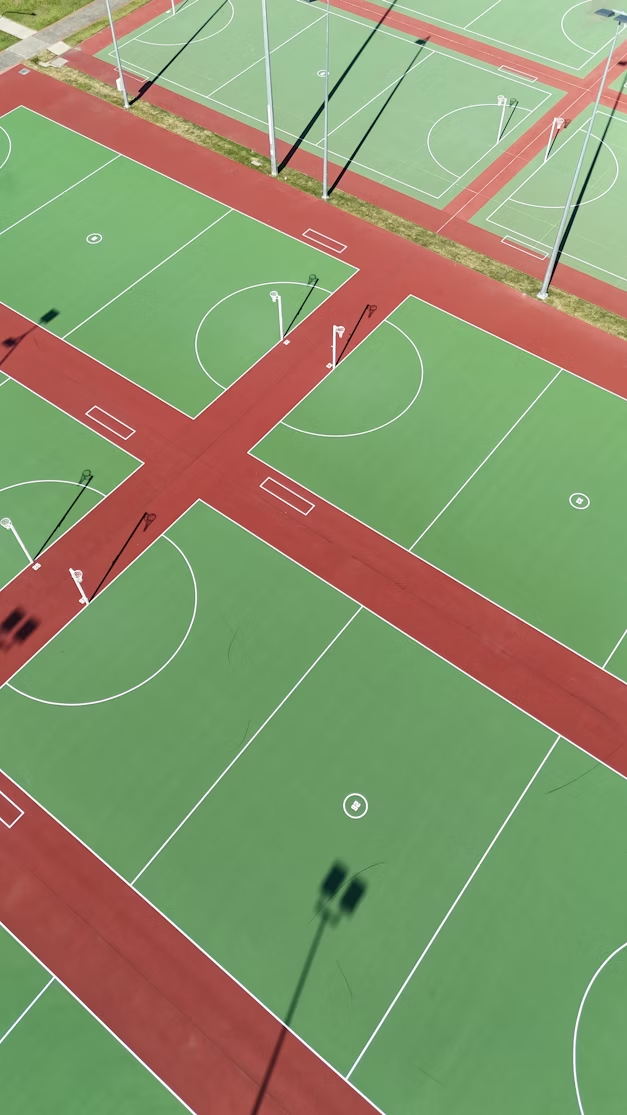
Netball is one of the world’s most popular female team sports played passionately across Australia, New Zealand, the UK, South Africa, and much of the Commonwealth. It’s a sport built on speed, agility, and precision, with athletes executing explosive movements, rapid changes of direction, and high volumes of jumping and landing, often under fatigue.
Despite netball’s popularity, performance monitoring in netball has historically lagged behind other professional sports. Many teams continue to rely on traditional fitness tests and subjective observation to make decisions about athlete readiness, return to play, and long-term player development. But that’s starting to change…
With the growing accessibility of portable force technology, netball programs now have the opportunity to bring objective data into the conversation, whether at the national, club, or youth level. Force assessment offers powerful insights into how athletes generate and absorb force, recover between sessions, and move across the performance-to-injury spectrum.
This blog explores how and when to use force measurement technology in netball, the benefits they offer for injury resistance and performance, and why the global netball community is uniquely positioned to lead the next evolution in athlete monitoring.
Why Force Assessment Belongs in Netball
Netball is a sport of margins. A mistimed jump, a poorly controlled landing, or a moment of fatigue can change the outcome of a game or a season. The demands placed on netball athletes are unique: high-speed directional changes, explosive vertical jumps, repeated decelerations, and frequent single-leg landings in tight, contested spaces.
Despite these demands, many programs still rely on limited testing methods, e.g., timed runs, jump mats, or subjective observation. While these can provide some insight, they don’t tell the full story. Objective force assessment tools, like force plates and the Hawkin TruStrength device, offer a more complete, real-time picture of how athletes generate, absorb, and control force.
Here’s what force assessment can uncover in netball:
- How much force is being produced during a jump or absorbed during a landing
- Whether an athlete is favoring one limb over another, even subtly
- How fatigue affects movement quality over the course of a match or tournament
- If an athlete is physically prepared to return to competition after injury
- Whether your strength program is actually driving neuromuscular change
Why combine force plates with isometric testing?
Force plates excel at capturing whole-body, dynamic tasks such as jumping, landing, and braking (movements that are highly relevant to netball performance). However, they don’t always tell you why a deficit exists.
This is where isometric testing using Hawkin TruStrength adds a critical layer of insight.
While some isometric assessments can be performed using a single force plate, the TruStrength offers several practical advantages that are particularly valuable in applied netball environments:
- Portability and flexibility: The TruStrength fits into a single carry case and can be used anywhere, in the gym, clinic, courtside, or during tournaments.
- Targeted, joint-specific testing: The TruStrength allows practitioners to isolate specific muscle groups (e.g., adductors, hamstrings, calf complex, and shoulder) under highly controlled conditions.
- Clinically relevant strength data: Isometric tests are often better tolerated early in rehab and provide clear benchmarks for strength restoration when dynamic testing may still be inappropriate.
In practice, force plates identify the presence of a performance or movement issue, while TruStrength helps pinpoint where that issue originates.
For example:
- A player may demonstrate symmetrical CMJ height and power on force plates, yet an isometric adductor assessment on the TruStrength reveals a meaningful adductor strength asymmetry, a key consideration given the lateral and cutting demands of netball.
- During a congested tournament schedule, isometric hamstring or calf testing with the TruStrength can be completed courtside in minutes, offering a low-fatigue snapshot of muscle readiness without requiring jumps or high-impact tasks.
- In early-stage return to play, an athlete may not yet tolerate jumping tasks, but TruStrength-based isometric testing allows objective monitoring of strength recovery long before dynamic clearance.
- Upper-body and trunk assessments (e.g., shoulder or neck isometrics), which are difficult or impractical to assess on force plates, can be easily integrated using the TruStrength to support contact readiness and postural control.
Together, force plates and the Hawkin TruStrength allow practitioners to assess both global movement output and local force capacity, creating a more complete picture of athlete performance, fatigue, and injury risk. Importantly, this level of insight is no longer confined to high-performance labs; portable, easy-to-use systems mean netball programs at all levels can now bring objective force assessment into daily practice.
Integrating Force Testing in Netball: Practical Applications
Force assessment isn’t just for high-performance labs; it’s a practical, scalable tool that can be embedded into everyday netball environments. Whether you’re working with elite athletes, youth development squads, or return-to-play cases, the combination of dynamic jump testing and isometric strength testing can offer a well-rounded picture of physical preparedness.
Here’s how you may structure force technology integration based on three different goals: performance profiling and injury resistance, fatigue monitoring and player readiness, and return to play.
1. Performance Profiling and Injury Resistance
Recommended Tests:
- Countermovement jump (CMJ)
- Isometric mid-thigh pull (IMTP) or isometric harness squat
- Isometric calf raise
- Isometric 90:20 hamstring
- Isometric Hip adduction
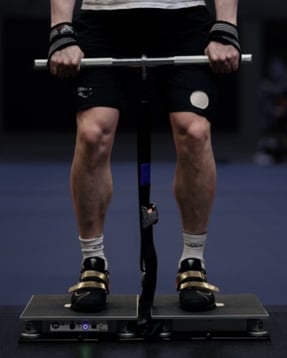
Figure 1: Isometric mid-thigh pull with TruStrength
Performance profiling can be planned for the start and end of a training block. You can use these tests more frequently, i.e., every week or every few weeks, as the assessments do not require large amounts of set-up, equipment, and they are portable. That means you can monitor your athletes in the gym or courtside before a court training! By collecting athlete data more frequently, you start to build up your base of athlete data, which can help you identify their ‘normal’ scores and values for each test, which can then help you identify potential ‘red flags’ or ‘injury risks’ if any dips in metrics were to occur. Additionally, you are also building your own normative data set for your athletes! Table 1 outlines a very basic approach to begin your force assessment journey in netball for performance profiling.
Table 1: Basic approach to force assessment for performance profiling in netball
|
Test |
Technology |
Metrics |
Reason |
|
Countermovement Jump (CMJ) |
Force plates |
|
The CMJ gives us insight into an athlete’s lower-body propulsive power, which is important for being explosive and jumping high, but it also gives us a look at their braking capabilities, landing technique, and asymmetries, which are important for injury resistance. |
|
Isometric Mid-Thigh Pull (IMTP) or Harness Squat |
Force plates or TruStrength |
|
The IMTP or harness squat is a great, quick, and safe method for assessing your athletesmaximal strength pre- and in-season. Through this assessment, you can get insight into both their maximal strength (peak force) capability, as well as their explosive strength (PRFD). |
|
Isometric Calf Raise |
Force plates or TruStrength |
|
In netball, plantar flexor muscles are chronically loaded, and their capacity is a key determinant of movement economy and explosiveness. Tracking plantarflexor strength throughout the season can help monitor changes longitudinally for load management and rehabilitation progress. |
|
Isometric 90:20 Hamstring |
Force Plates or TruStrength |
|
Hamstring strength contributes to horizontal force production during sprinting and braking, both of which are demands of netball. The 90:20 test is also a great option for monitoringneuromuscular fatigue. |
|
Isometric Unilateral Hip Adduction |
TruStrength |
|
Adductor strength is critical for the rapid changes of direction, cutting, and defensive shuffling that are common in netball. Reduced adductor strength has been linked to an increased risk of groin pain and related injuries. Regular profiling with the hip adduction testprovides objective benchmarks of adductor capacity, helps detect asymmetries, and supports both injury prevention and targeted training strategies. |
2. Fatigue Monitoring and Player Readiness
Recommended Tests:
- Countermovement Jump (CMJ)
- Isometric 90:20 hamstring
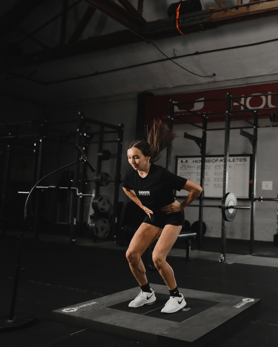
Figure 2: CMJ
Fatigue and readiness monitoring is about identifying how well an athlete is coping with training and competition demands. Even when athletes “feel fine,” subtle reductions in jump performance or hamstring force can be early indicators of accumulated fatigue, under-recovery, or elevated injury risk.
The CMJ is one of the most widely validated tools for this purpose. Metrics such as jump height, time to take off, eccentric braking forces, and modified reactive strength index (mRSI) are all sensitive to neuromuscular fatigue 1-3. Because the CMJ is quick, non-fatiguing, and easy to integrate into warm-ups, it is ideal for tracking day-to-day or weekly readiness.
The isometric 90:20 hamstring test can complement CMJ monitoring, particularly in sports like netball, where hamstring load is high during sprinting, deceleration, and changes of direction. Reductions in isometric hamstring force after competition have been shown to reflect residual fatigue 4, and consistent monitoring can help flag when players may be at greater risk of overload or injury.
By collecting these tests consistently, you establish each athlete’s “normal” range, which makes it easier to spot unusual dips. For example, a >10% drop in CMJ mRSI or hamstring force compared to baseline might trigger adjustments in training load, recovery strategies, or athlete monitoring. Over time, this builds a clearer picture of how each athlete responds to different training and competition demands, allowing coaches and support staff to make more confident, data-informed decisions. Table 2 outlines a very basicapproach to begin your force assessment journey in netball for fatigue monitoring and athlete readiness.
Table 2: Basic approach to force assessment for fatigue monitoring and athlete readiness in netball
|
Test |
Technology |
Metrics |
Reason |
|
Countermovement Jump (CMJ) |
Force plates |
|
The CMJ is highly sensitive to neuromuscular fatigue, with variables such as jump height, eccentric braking impulse, contraction time, and reactive strength index modified (mRSI) reflecting readiness to train or compete. Because it is quick, portable, and non-fatiguing, the CMJ is ideal for frequent monitoring to detect dips in performance and guide load management. |
|
Isometric 90:20 Hamstring |
TruStrength |
|
Hamstring force output is often reduced following high-intensity competition, making this test useful for detecting residual fatigue and monitoring recovery. Regular assessment helps identify when an athlete may be at elevated risk of overload or soft tissue injury, particularly in sports with frequent sprinting and decelerations like netball. |
3. Return to Play (RTP)
Recommended Tests (lower limb injury):
- Countermovement jump (bilateral and unilateral)
- Isometric strength tests for the injured limb/muscle group
- Landing asymmetry and eccentric braking assessment
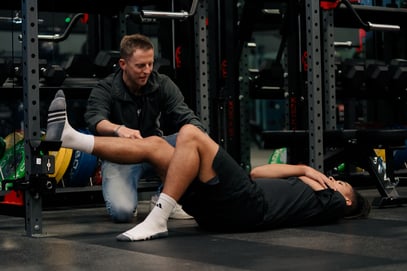
Figure 3: Supine 30 30 Hamstring
Return to play is one of the most critical stages in the athlete's journey, but also one of the most complex. Relying solely on timelines or subjective judgments can expose athletes to reinjury. Instead, force assessment offers objective benchmarks to guide decision-making at each stage of rehabilitation.
The CMJ (both bilateral and unilateral) is a cornerstone RTP test. Bilateral CMJs provide insight into overall neuromuscular recovery, while single-leg CMJs are especially valuable for detecting side-to-side differences in jump height, power, or force application. These tests help ensure the injured limb has regained sufficient explosive capacity before full competition exposure.
Isometric strength tests allow precise targeting of the injured muscle group or joint. For example, the 90:20 hamstring test for hamstring injuries, the unilateral hip adduction test for adductor issues, or the isometric calf raise for calf and Achilles rehab. Tracking force and symmetry over time provides a clear picture of recovery and helps clinicians set progression thresholds. Here is another blog post that may be of interest to you regarding the stages of rehabilitation and the best metrics to track during each stage, measured with the TruStrength.
Finally, landing asymmetry and eccentric braking assessment via a drop landing assessment gives an added layer of return-to-sport confidence. Many injuries occur during high-load landing or deceleration tasks, so assessing how well athletes control force during these actions is critical. Reductions in asymmetry (<10–15% between limbs) and restoration of eccentric braking metrics are key markers of readiness to return to sport.
When combined, these tests move RTP decisions from guesswork to evidence-based practice, giving athletes, coaches, and clinicians confidence that return is not just possible, but safe and sustainable. Table 3 outlines a very basic approach to begin your force assessment journey in netball for return to play.
Table 3: Basic approach to force assessment for return to play in netball.
|
Test |
Technology |
Metrics |
Reason |
|
Countermovement Jump (bilateral and unilateral) |
Force plates |
|
The CMJ identifies whether explosive power, jump mechanics, and inter-limb asymmetry have returned to safe levels. Bilateral jumps reflect overall recovery, while unilateral jumps can be more sensitive to side-to-side deficits common after lower limb injury. |
|
Isometric strength tests (injured limb/muscle group) |
TruStrength |
|
Targeted isometric tests (e.g., hamstring 90:20, hip adduction, calf raise, quadriceps test) provide objective benchmarks of force restoration in the injured area. These tests help confirm strength symmetry and reduce reinjury risk. |
|
Landing asymmetry & eccentric braking assessment (CMJ & drop landing assessment) |
Force plates |
|
Many netball injuries occur during landings or decelerations. Assessing landing mechanics and eccentric braking ensures athletes can safely absorb high forces and control movement before returning to full competition. |
Conclusion
Now I know it seems like a lot, but each one of these assessments takes a few minutes to complete and requires minimal equipment and set-up time compared to traditional assessment methods such as 1 rep max strength assessments. More feedback we commonly hear is that practitioners are struggling with the choice of metrics to track and monitor. The metrics recommended in the table are just a few basic metrics you can look at. If you want the full list of metrics, head to our metrics database: https://www.hawkindynamics.com/hawkin-metric-database.
Please also note that this is a basic approach to force integration in netball. Each goal, i.e., performance profiling, injury resistance, athlete readiness, and RTP, could each have an entire blog post on its own, with many more assessments you can include. If you have a specific case you want to discuss, please reach out to our research and education team.
Force assessment in netball doesn’t need to be complicated. With the right tools, you can integrate objective testing into warm-ups, training sessions, or rehabilitation programs in just a few minutes. By combining jump analysis with isometric strength testing, you build a clearer picture of each athlete’s performance, readiness, and recovery. The result is smarter decisions, fewer injuries, and stronger athletes. The next step is simple: start testing, start tracking, and let the data guide you.