
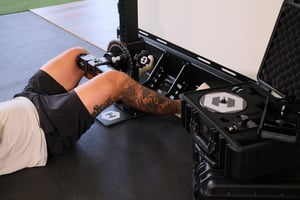
TruStrength Dynamometer and The Pivot
Athletes don’t stay in one room. They train in a gym, rehab in a clinic, and travel to compete. If the setup changes every time the testing moves, you can’t trust the data coming back.
TruStrength solves this with two pieces: the TruStrength with the Pivot at home base, and the TruStrength Total Kit for everywhere else.
Fixed dynamometry means measuring muscular force production against an immovable anchor point rather than a tester's hands (the latter of which is known as handheld dynamometry). With fixed dynamometry, the athlete pushes or pulls against a rigid frame while the dynamometer (i.e., a load cell) records the result. Isokinetic dynamometry (IKD) remains the gold standard for both isokinetic (fixed velocity) and isometric muscular strength testing, but it's lab-bound equipment. The TruStrength has been validated against IKD and is the best portable alternative: fixed, rigid, and consistent wherever the test happens.
The Pivot: your fixed dynamometry home base
Isometric testing is quick, simple, and low in fatigue, which has made it a staple of in-season monitoring in sports (McCall et al., 2015; Wollin et al., 2017). But the reliability of any metrics depends on the set-up, not the test. Ripley et al. (2025) showed the 90:90 isometric hamstring test is reliable between sessions only when the set-up, instructions, data collection, and analysis follow a consistent procedure.
The Pivot has that procedure built into the hardware:
- Fixed frame: force goes into the measurement, not the set-up. [4000 N system tolerance]
- Fully adjustable: 250 degrees of rotation on two axes matches force application to the protocol.
- Repeatable: record angles and heights used on the Pivot once per test per athlete, then return to them every session.
- Tensile and compression: pull or push, depending on the protocol.
- Limitless protocols: from neck to foot.
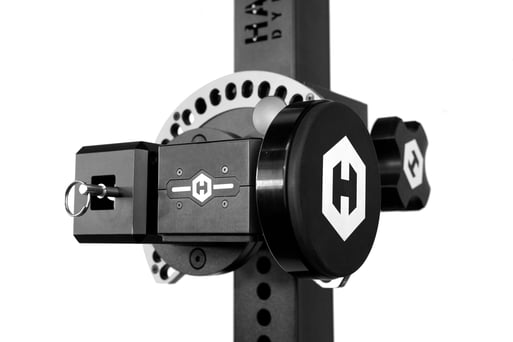
The Pivot
Single Setup. Continuous Testing.
The TruStrength Total Kit: the same protocol on the road
The majority of the research behind hamstring and shoulder testing uses lab-based IKD, which limits how often testing can happen in practice (Job et al., 2024). The Total Kit allows your TruStrength to travel to other gyms, physio clinics, hotels, remote locations, or even a client’s own environment, with two mounting options.
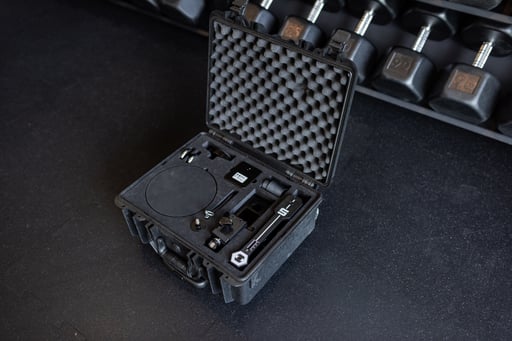
TruStrength Dynamometer Total Kit
The Pivot defines the protocol. The Total Kit replicates it wherever your athletes are.
- Rack mount: for any venue with a gym rack or solid square post
- Floor mount: weight plates or a box achieve the desired height, no rack needed
Two TruStrengths: home and away at once
With two TruStrengths, one travels with the Total Kit while the other stays on the Pivot. The Pivot works with a single TruStrength, so athletes who aren’t traveling can be tested exactly as before. Your home base never has to be packed down. When the squad returns, both devices can run together on the Pivot in paired TruStrength Mode for bilateral tests such as the groin squeeze.
One app, one cloud, one standard of data
Both setups feed the same Hawkin app and cloud account, so every trial gets the same data processing and onset detection, whether you’re on the Pivot or in a hotel gym.
You can trust that data. TruStrength showed no meaningful differences from IKD for peak force or peak rate of force development (Oranchuk et al., 2023), and good-to-excellent reliability across hamstring assessments (Woodbridge et al., 2024).
Every trial returns the same metrics:
- Peak Force: the highest force produced in the trial
- Peak Net Force: peak force above pretension
- Time to Peak Force: the time from the beginning of the repetition until peak force was achieved
- Average Force: The mean force applied during the repetition.
- Average Net Force: The mean net force applied during the repetition
- Net Force at 50, 100, 150, 200 and 250 ms: the net instantaneous force applied at each time point during the repetition
- Peak RFD: the peak instantaneous RFD applied during the repetition
- Total Impulse: The total impulse (area under the force-time curve) applied during the repetition.
- Net Impulse: the net total impulse (area under the force-time curve to the pretension line) applied during the repetition
- Explosive Strength Index: The net peak force over the time to peak force.
- Pretension: force held before the effort. Keeping it consistent standardises the starting point, so net force is comparable across sessions and set-ups.
- Duration: The time between the start and the end of the repetition.
- Target: The target force for the repetition.
Why this Matters
Scenario 1: monitoring a hamstring on the road
Hamstring strains account for almost a quarter of injuries in men’s professional football (Ekstrand et al., 2023) and can occur within around 0.1 s of foot contact with the ground (Heiderscheit et al., 2005). Eccentric screening is poorly adopted (Bahr et al., 2015; Ekstrand et al., 2022), and pre-season testing offers little insight into future injury (Opar et al., 2021). Hamstring strength drops after match play and through congested fixtures (Wollin et al., 2017, 2018), so frequent monitoring matters.
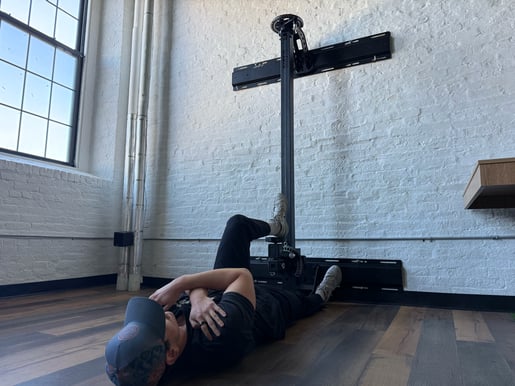
Hamstring 90:90 on the Pivot — supine 90:90, heel on TruStrength, athlete position locked
Ripley et al. (2025) found the 90:90 isometric hamstring test reliable for peak force (CV 2.8%) and force at 100 and 200 ms (CV 4.6–7.4%) using Hawkin force plates. TruStrength offers a portability option without compromising force signal processing. Woodbridge et al. (2024) confirms this directly on the TruStrength itself, reporting good-to-excellent reliability for peak force (CV 2.6–11.7%, ICC 0.74–0.99) across standing, supine 90:90, and standing 90:20 hamstring protocols.
Here’s how it plays out. A player returning from a hamstring strain shows an early-force deficit testing on the 90:90 isometric hamstring test on the Pivot at the facility. The next day, the squad travels. You run a road baseline on day one using the floor mount with a box or plates, which closely mirrors Ripley’s published set-up, then track peak net force and net force at 100 and 200 ms after each session. The deficit stays visible all trip.
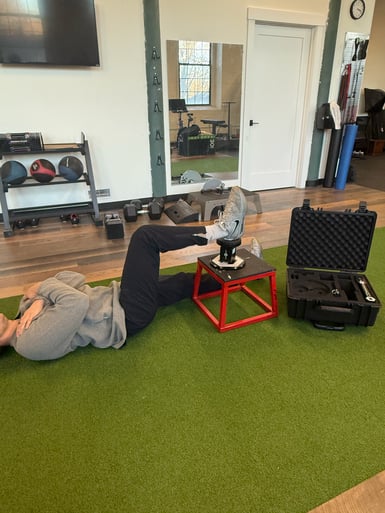
Hamstring 90:90 on the road — floor mount with box set-up
Scenario 2: shoulder profiling in baseball
Internal rotation velocity in pitching can exceed 6,500° per second (Fleisig et al., 1999), and pre-season external rotation weakness has been linked to throwing-arm surgery in professional pitchers (Byram et al., 2010). Rotator strength is also associated with throwing velocity (Clements et al., 2001; Cross et al., 2023).
Job et al. (2024) tested pitchers with the TruStrength at 90° of shoulder abduction, which produces greater external rotation output than 0°, likely through posterior shoulder recruitment (Escamilla et al., 2009). Angle choice changes what you measure. On the Pivot, you choose the angle (supine at 90°, seated at 0°, scaption) and fix it.
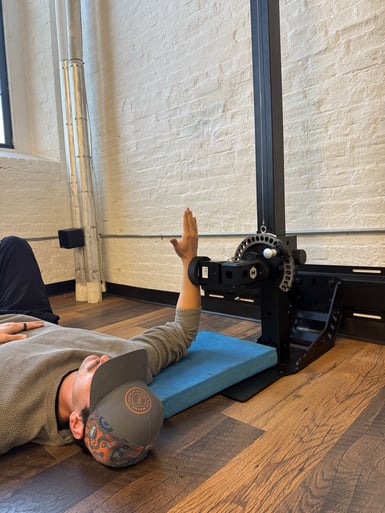

Shoulder IR/ER on the Pivot — Shoulder internal and external rotation fixed dynamometry test on the Pivot
The Total Kit takes the same protocol into high schools, public gyms, and community baseball. In Job et al., every 30 N of external rotation peak force went with ~0.7 m/s (~1.6 mph) more velocity. Build reference values from your senior pitchers, then profile community athletes against them. Anyone near senior-level strength is worth a closer look.

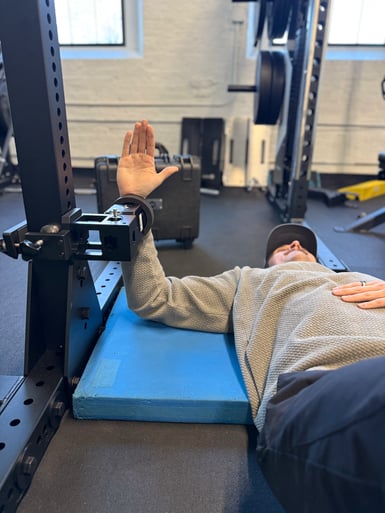
Shoulder IR/ER on the road — Portable shoulder IR/ER fixed dynamometry testing with the TruStrength Total Kit
Caution: Strength explained only 12-13% of the variation in velocity. Use it to screen, not to predict, as one flag alongside velocity, mechanics, and maturation.
Trusting your road data
- Baseline each set-up: road sessions need their own reference. TruStrength shows its largest session-to-session swings before a familiarisation session, then stabilises (Juneau et al., 2022).
- Compare like with like: road with road, Pivot with Pivot.
- Standardise: keep pretension, instructions and footwear consistent, and tag the set-up.
The Bottom Line
Define the protocol on the Pivot. Take it anywhere with the Total Kit. Capture it all in one app and one cloud account.
Data you can trust.
Read the paired TruStrength blog
Fixed dynamometry FAQs
What is fixed dynamometry?
Fixed dynamometry is force testing against an immovable frame: the athlete pushes or pulls against a rigid, fixed point while a load cell measures the output. Because the frame doesn't move, tester strength and stability are removed as variables — only the protocol and the athlete determine the result.
How is fixed dynamometry different from handheld or isokinetic dynamometry?
Isokinetic dynamometry (IKD) is the gold standard for strength testing, but it's lab-bound equipment that limits how often testing can happen in practice (Job et al., 2024). Handheld dynamometry is portable but relies on a tester holding the device steady, which limits load and repeatability. The TruStrength has been validated against IKD and is the best portable alternative: a fixed, rigid set-up that keeps the rigour of a lab-grade test without needing a lab.
Can fixed dynamometry testing travel with the team?
Yes. The TruStrength Total Kit mounts to a rack or the floor with a box or weight plates, replicating the Pivot's fixed set-up anywhere there's a rack or a solid floor — hotel gyms, physio clinics or community facilities.
Is fixed dynamometry data from the road comparable to data from the gym?
Only when set-up, instructions, pretension and footwear are standardised and each environment has its own baseline. Hawkin's app and cloud apply the same calculations and onset detection to every trial, on the Pivot or in a hotel gym — but road and gym baselines should still be compared like with like.
References
Bahr, R., Thorborg, K., & Ekstrand, J. (2015). Evidence-based hamstring injury prevention is not adopted by the majority of Champions League or Norwegian Premier League football teams: The Nordic Hamstring survey. British Journal of Sports Medicine, 49(22), 1466–1471. https://doi.org/10.1136/bjsports-2015-094826
Byram, I. R., Bushnell, B. D., Dugger, K., Charron, K., Harrell, F. E., Jr., & Noonan, T. J. (2010). Preseason shoulder strength measurements in professional baseball pitchers: Identifying players at risk for injury. American Journal of Sports Medicine, 38, 1375–1382.
Clements, A. S., Ginn, K. A., & Henley, E. (2001). Correlation between muscle strength and throwing speed in adolescent baseball players. Physical Therapy in Sport, 2, 123–131.
Cross, J. A., Higgins, A. W., Dziuk, C. C., Harris, G. F., & Raasch, W. G. (2023). Relationships among shoulder rotational strength, range of motion, pitching kinetics, and pitch velocity in collegiate baseball pitchers. Journal of Strength and Conditioning Research, 37, 129–135.
Ekstrand, J., Bengtsson, H., Waldén, M., Davison, M., & Hägglund, M. (2022). Still poorly adopted in male professional football: But teams that used the Nordic Hamstring Exercise in team training had fewer hamstring injuries. BMJ Open Sport & Exercise Medicine, 8(3). https://doi.org/10.1136/bmjsem-2022-001368
Ekstrand, J., Bengtsson, H., Waldén, M., Davison, M., Khan, K. M., & Hägglund, M. (2023). Hamstring injury rates have increased during recent seasons and now constitute 24% of all injuries in men’s professional football: The UEFA Elite Club Injury Study from 2001/02 to 2021/22. British Journal of Sports Medicine, 57(5), 292–298. https://doi.org/10.1136/bjsports-2021-105407
Escamilla, R. F., Yamashiro, K., Paulos, L., & Andrews, J. R. (2009). Shoulder muscle activity and function in common shoulder rehabilitation exercises. Sports Medicine, 39, 663–685.
Fleisig, G. S., Barrentine, S. W., Zheng, N., Escamilla, R. F., & Andrews, J. R. (1999). Kinematic and kinetic comparison of baseball pitching among various levels of development. Journal of Biomechanics, 32(12), 1371–1375.
Heiderscheit, B. C., Hoerth, D. M., Chumanov, E. S., Swanson, S. C., Thelen, B. J., & Thelen, D. G. (2005). Identifying the time of occurrence of a hamstring strain injury during treadmill running: A case study. Clinical Biomechanics, 20(10), 1072–1078. https://doi.org/10.1016/j.clinbiomech.2005.07.005
Job, T. D. W., III, Cross, M. R., & Cronin, J. B. (2024). Relationship of shoulder internal and external rotation peak force and rate of force development to throwing velocity in high school and collegiate pitchers. Journal of Biomechanics, 176, 112339. https://doi.org/10.1016/j.jbiomech.2024.112339
Juneau, C. M., Diewald, S. N., Neville, J., Cronin, J. B., & Oranchuk, D. J. (2022). Intersession variability of knee extension kinetics using a strain gauge device with differing clinically practical physical constraints. Journal of Sport Rehabilitation. Advance online publication. https://doi.org/10.1123/jsr.2022-0152
McCall, A., Nedelec, M., Carling, C., Le Gall, F., Berthoin, S., & Dupont, G. (2015). Reliability and sensitivity of a simple isometric posterior lower limb muscle test in professional football players. Journal of Sports Sciences, 33(12), 1298–1304. https://doi.org/10.1080/02640414.2015.1022579
Opar, D. A., Timmins, R. G., Behan, F. P., Hickey, J. T., van Dyk, N., Price, K., & Maniar, N. (2021). Is pre-season eccentric strength testing during the Nordic hamstring exercise associated with future hamstring strain injury? A systematic review and meta-analysis. Sports Medicine, 51(9), 1935–1945. https://doi.org/10.1007/s40279-021-01474-1
Oranchuk, D. J., Juneau, C. M., Diewald, S. S., Neville, J., & Cronin, J. B. (2023). The validity of a portable strain-gauge apparatus versus a commercial isokinetic dynamometer for evaluating knee extension kinetics [Preprint]. Research Square. https://doi.org/10.21203/rs.3.rs-2958221/v1
Ripley, N. J., Fahey, J., Cuthbert, M., McMahon, J. J., & Comfort, P. (2025). Rapid force generation during unilateral isometric hamstring assessment: Reliability and relationship to maximal force. Sports Biomechanics, 24(11), 3218–3229. https://doi.org/10.1080/14763141.2023.2276316
Wollin, M., Thorborg, K., & Pizzari, T. (2017). The acute effect of match play on hamstring strength and lower limb flexibility in elite youth football players. Scandinavian Journal of Medicine & Science in Sports, 27(3), 282–288. https://doi.org/10.1111/sms.12655
Wollin, M., Thorborg, K., & Pizzari, T. (2018). Monitoring the effect of football match congestion on hamstring strength and lower limb flexibility: Potential for secondary injury prevention? Physical Therapy in Sport, 29, 14–18. https://doi.org/10.1016/j.ptsp.2017.09.001
Woodbridge, R., Ryan, C., Burkitt, J., Ye-Lee, D., & Cronin, J. (2024). Reliability of a portable fixed dynamometer during different isometric hamstring assessments. Applied Sciences, 14(22), 10202. https://doi.org/10.3390/app142210202
